
Reformer Pilates for Runners: Why Dallas’s Katy Trail Crowd Is Cross-Training at BE Fit
Yes, reformer Pilates is one of the most effective cross-training workouts for runners. It strengthens the deep core, glutes, and hip stabilizers that running tends to neglect, corrects the muscle imbalances that cause IT band pain and shin splints, and improves stride efficiency, all without adding the joint impact runners are already managing.
If you train on the Katy Trail, log loops at White Rock Lake, or follow a Cowtown or BMW Dallas Marathon training plan, the case for adding one or two reformer sessions a week is clear. Here is what the workout does for runners, what it fixes that running alone cannot, and which BE Fit Dallas studio fits your training corridor.
How does reformer Pilates help running?
Running is a one-plane, repetitive sport. You move forward, you load one leg at a time, and you repeat the same motion thousands of times in a single run. That builds endurance, but it does not build lateral strength, rotational control, or single-leg stability, the three things that hold your form together in the back half of a long run.
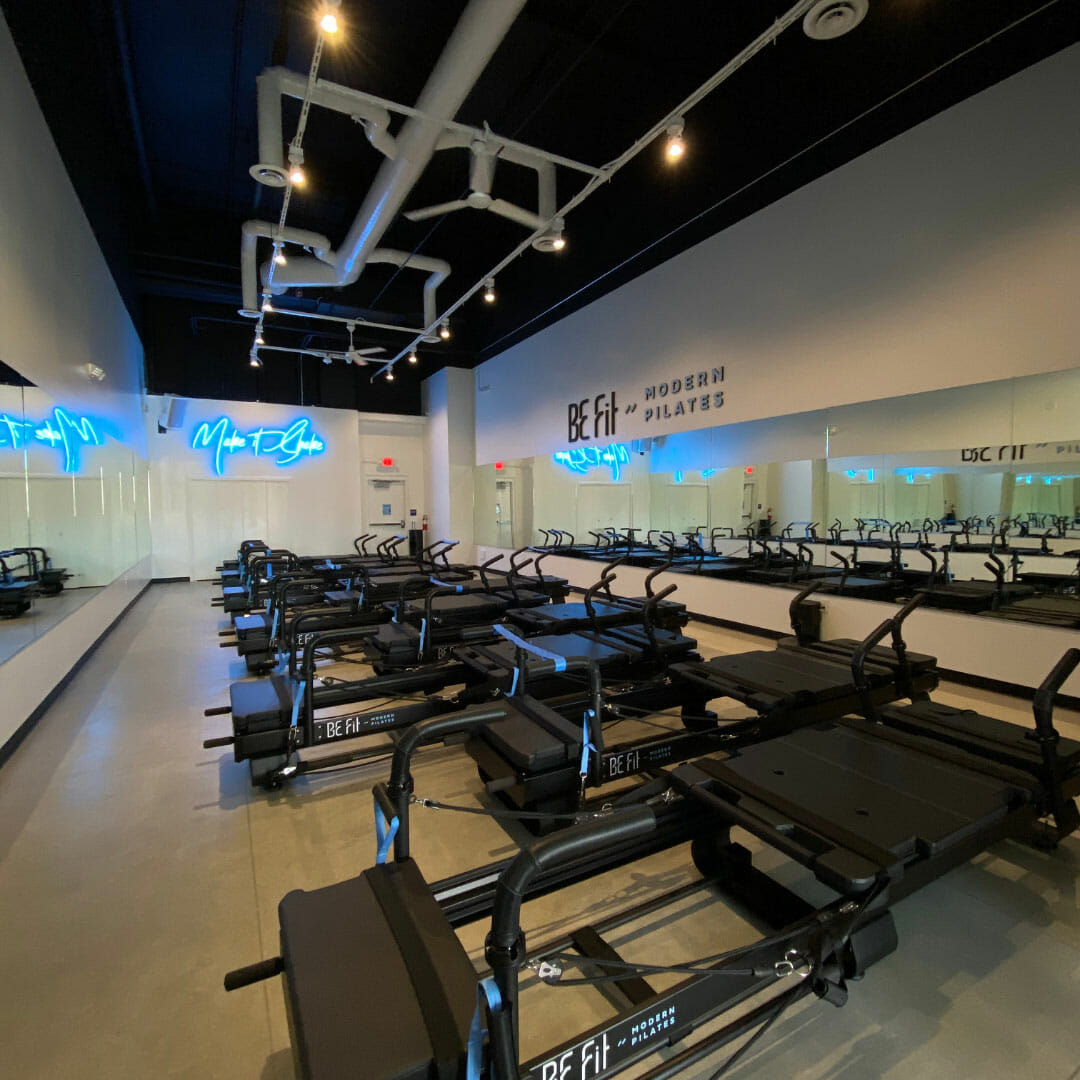
Reformer Pilates fills those gaps. The XFormer’s spring resistance forces you to work through full ranges of motion under load while controlling deceleration, which is exactly what your hips, glutes, and core do every time your foot hits the ground. The result is a stronger, more stable runner who holds form longer and gets injured less.
Pilates moves that translate directly to running
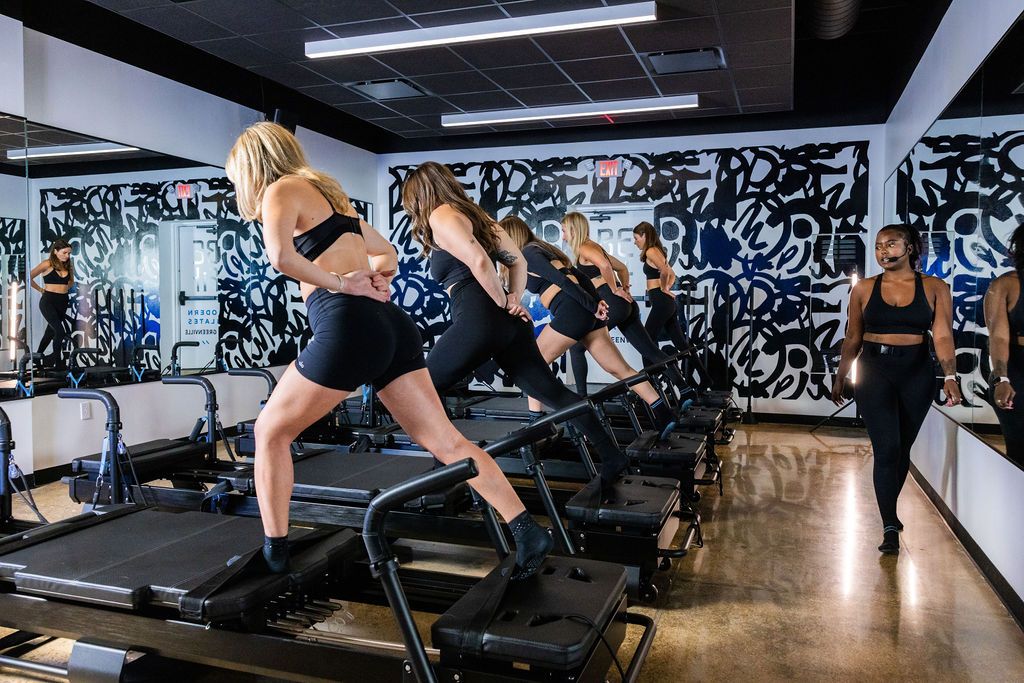
Not every Pilates exercise has a running application, but the ones in BE Fit’s Make It Shake™ format hit the patterns runners need most. These are the moves that pay off on the road.
Footwork: stride mechanics and ankle stiffness
The opening footwork sequence on the XFormer loads your feet, calves, and ankles through slow, controlled extension and flexion under spring resistance. That is the same chain that propels you forward on every stride. Stronger, springier ankles mean better ground contact and less energy leaking out of your run.
Single-leg work: hip stability and IT band relief
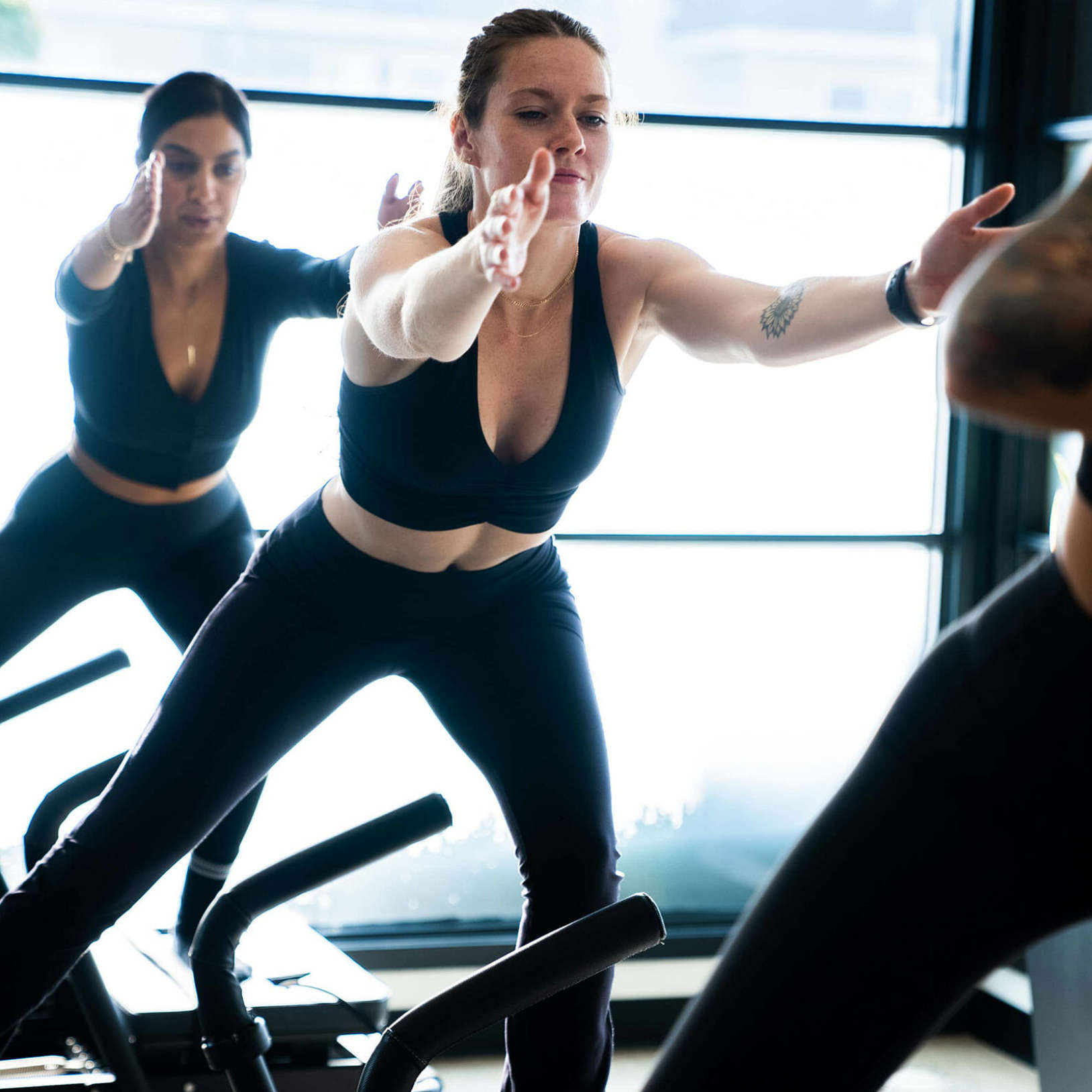
Single-leg lunges, kneeling stretches, and split-leg work on the XFormer build the gluteus medius, the small but critical hip stabilizer that controls how your knee tracks when you run. A weak glute medius is the single most common cause of IT band pain, runner’s knee, and inner-knee collapse on tired legs.
Plank progressions: late-race posture
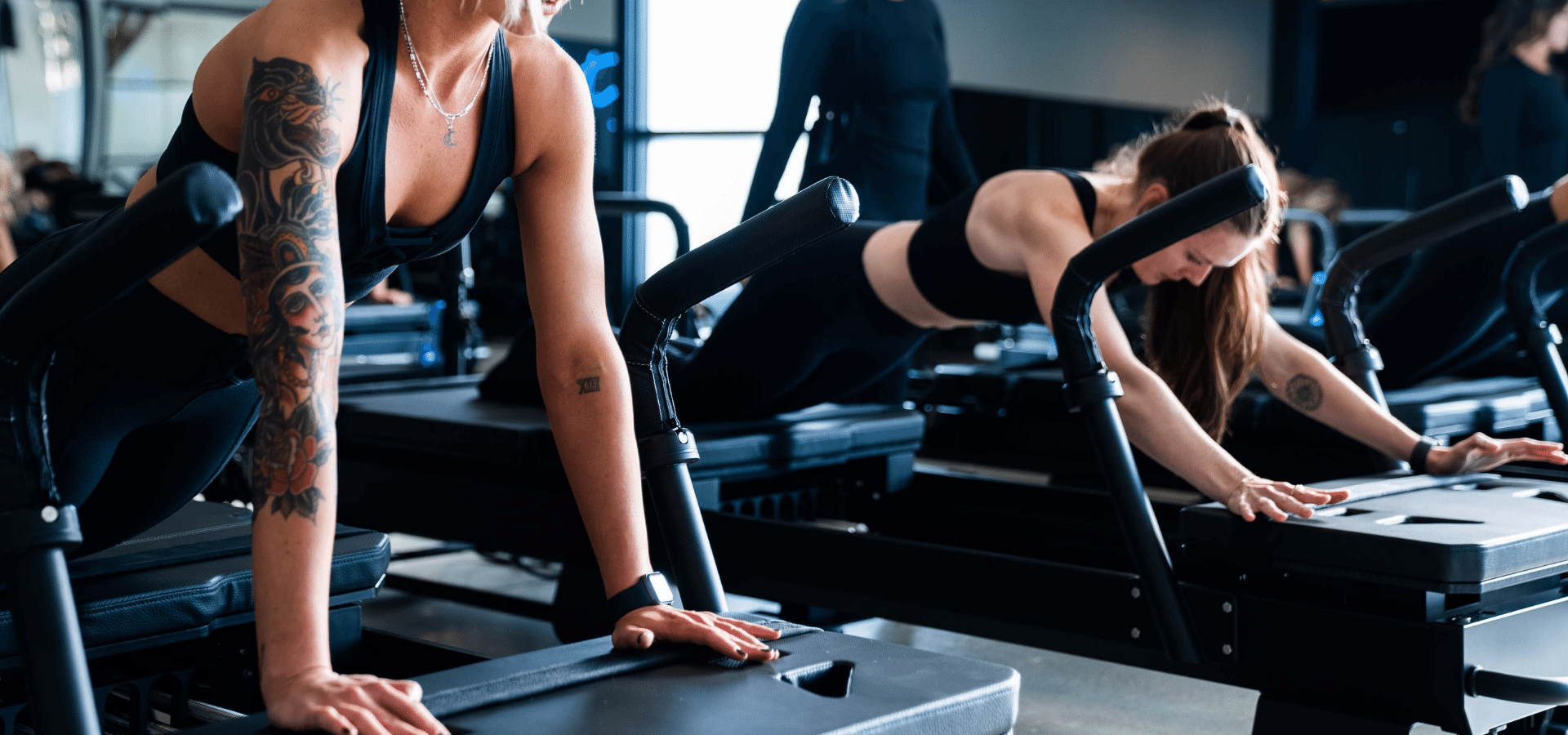
The plank variations on the XFormer (long arm planks, knee tucks, mountain climbers under spring load) train the deep core to hold a stable rib-to-pelvis position. That is the exact posture that breaks down at mile 18 of a marathon, the breakdown that costs you minutes and sets up post-race lower back pain.
Eccentric loading: downhill running and recovery
Slow lowering phases on the XFormer (think slow leg-press returns or controlled hamstring curls) build eccentric strength, your muscle’s ability to lengthen under load. This is the strength that protects your quads on downhills and the strength that controls how hard your foot lands. It is also the strength most runners are weakest in.
Common Dallas runner overuse patterns and how reformer work fixes them
Dallas runners deal with a specific set of overuse patterns that come from the geography and climate. After 16 years working with local athletes, here are the three patterns we see most, and the reformer work that addresses them.
One-sided hip imbalance from the Katy Trail
The Katy Trail is not perfectly flat. Like most paved trails, it slopes slightly for water runoff, and most runners use the same side on every out-and-back. Over months, that creates a measurable hip-height difference and one tight IT band. Single-leg footwork and lateral spring work on the XFormer rebuild even loading on both sides.
Shin splints from summer heat overtraining
Dallas summers force runners into early-morning pavement pounding on legs that did not recover from yesterday’s run. The result is shin splints, calf tightness, and a slow grind toward stress reactions. Reformer Pilates builds your running muscles without the impact, which is exactly what your shins need when summer mileage stacks up.
Tight hip flexors from the desk-to-run lifestyle
Most Dallas runners sit at a desk all day before they lace up. By the time you hit the trail, your hip flexors have been shortened for nine hours, and your glutes have been silent. That tight-front, sleepy-back pattern is what kills your stride length. The bridge work, hip openers, and glute-focused sequences on the XFormer wake up the back side of your body before your next run.
How often should runners do reformer Pilates?
Two reformer sessions per week is the cadence that produces the most consistent results. One session is maintenance. Two is when you start to feel the difference in your stride and your recovery. Three is for runners training for a goal race who want maximum cross-training benefit on top of their mileage.
During peak marathon training weeks (the 12 weeks leading into the BMW Dallas Marathon in December or the Cowtown Marathon in late February), most BE Fit runners drop to one session per week to make room for long runs and recover better between hard efforts. The mistake is dropping to zero.
When should I do Pilates, before or after a run?
For most runners, Pilates works best on a separate day from your hard runs, or after an easy run on the same day. A 45-minute Make It Shake™ class will fatigue your stabilizers, and you do not want fatigued stabilizers when you hit a tempo workout or a long run.
If you have to combine them, run first, then take class. A Pilates session before a hard run leaves your form vulnerable. A Pilates session after gives you the cross-training benefit without compromising the run.
Which BE Fit Dallas studio fits your training corridor?
Every BE Fit Dallas studio sits within a few minutes of one of Dallas’s major running corridors. Here is which one fits your weekly route.
BE Fit West Village: Katy Trail runners
3636 McKinney Ave, Suite 130, Dallas, TX 75204. West Village sits steps from the Katy Trail. If your weekday runs are out-and-backs from the McKinney Avenue access point or the Knox-Henderson trailhead, this is your studio. Park in the West Village garage, run the trail, and head to class. Strong pick for Uptown and Highland Park runners.
BE Fit Lovers Lane: Turtle Creek and Katy Trail north
5509 W Lovers Lane, Suite A, Dallas, TX 75209. The Lovers Lane studio is minutes from the north end of the Katy Trail and the Turtle Creek running path. If you live in Highland Park, University Park, or Bluffview and your weekly route winds through Turtle Creek, this is the closest BE Fit. Parking is easier here than at the Uptown studio.
BE Fit Lower Greenville: White Rock Lake runners
3020 Greenville Ave, Dallas, TX. Lower Greenville is the closest BE Fit to White Rock Lake, the de facto Dallas running mecca. If you log your long runs around the 9.3-mile lake loop or hit Flag Pole Hill for hill repeats, this studio is your post-run reset. Strong pick for M Streets, Lakewood, and East Dallas runners training for the BMW Dallas Marathon, since the race course runs right around the lake.
BE Fit Southlake: DFW and Cowtown training crowd
2645 E. Southlake Blvd., Southlake, TX 76092. The Southlake studio sits in the middle of the DFW northwest running community, with easy access to Bicentennial Park and the Southlake Town Square loop. If you train for the Cowtown Marathon in Fort Worth or run with one of the Southlake or Grapevine clubs, this is the BE Fit that fits your week.
How to add reformer Pilates to your weekly running schedule
The cleanest way to layer reformer Pilates into a running plan without overdoing it:
- Pick your two highest-priority running days (usually long run and tempo or speed). These stay running-only.
- Book your first BE Fit class on a day after an easy run or a true rest day. Tuesday and Thursday work well for most runners.
- Schedule your second BE Fit class at least 36 hours before your next hard workout. Stabilizer fatigue is real, and you want fresh hips on speed day.
- During race week, drop to one Pilates session three to four days out from race day. Do not skip it entirely. A short session keeps your hips firing without adding load.
- Post-race, take two to three days off everything, then come back to Pilates before your next run. It is the easiest reentry workout for tired legs.
Frequently asked questions about reformer Pilates for runners
Will Pilates make me a faster runner?
Not directly, but indirectly yes. Pilates does not train your aerobic system, so it will not lower your VO2 max. What it does is make your running mechanics more efficient, which means less energy wasted per stride, which translates to faster times at the same effort.
Can I do reformer Pilates on a rest day?
Yes, but understand it is not a true rest day if you take a hard reformer class. For an active recovery day, take a slower class or schedule reformer on a true off-day so your hard sessions and long runs stay protected.
Does Pilates help with IT band syndrome?
Yes. IT band pain is almost always a hip stability problem, not a tight-band problem. The single-leg and glute medius work on the XFormer addresses the root cause, which is why many Dallas runners come to BE Fit on PT recommendations.
Is reformer better than mat Pilates for runners?
For most runners, yes. The XFormer’s spring resistance lets you load single-leg work, eccentric lowering, and plank progressions harder than bodyweight mat work allows. The result is more strength gain per session.
Does Pilates help running form?
Yes, especially in the late miles of long runs. Pilates trains the deep core and postural muscles that hold your rib cage stacked over your pelvis. When those muscles fatigue, your form breaks down. Stronger postural muscles mean better form at mile 20.
Will Pilates replace strength training for runners?
No. Reformer Pilates is the best complement to a runner’s lifting routine because it covers the small stabilizers that heavy lifts miss. If you can do both, do both. Most BE Fit runners do reformer twice a week plus one short lifting session.
Ready to add it to your training?
Book your first BE Fit class at the studio closest to your running corridor. Most runners feel the difference in their hips within three sessions. New clients should look for the intro offer to try a few classes before committing.