
Reformer Pilates for Surfers and Paddlers: Building Paddle Endurance Without More Shoulder Wear
Yes, reformer Pilates is good for surfers, and it targets the three systems surfing actually loads: paddle endurance through the lats and the muscles that stabilize your shoulder blades, rotational core strength for turns, and hip mobility and single leg power for the pop up. It builds those without adding the repetitive overhead volume that a longer paddle session adds.
That last part is the whole argument. Most surfers who want better paddle stamina try to get it by paddling more, which trains endurance and accumulates shoulder wear at the same time. Time under tension on the XFormer® gives you the endurance stimulus with the load coming from springs instead of from another two hours of overhead reaching.
What surfing actually asks of your body
Break a session down and the physical demands are pretty specific. Most of a surf session is not surfing.
Paddle endurance
You spend the majority of your water time paddling. That is a long, repetitive pulling motion driven by the lats, the muscles around your shoulder blades, and your upper back, with your core holding you in extension on the board the entire time. It is an endurance demand, not a max strength demand. The thing that gasses you on the last wave of a session is not that your lats are weak, it is that they cannot hold output for 90 minutes.
Rotation for turns
Every turn is your torso rotating against a base that is moving underneath you, then resisting rotation to hold the line. Both halves matter. Surfers tend to train the rotating part and skip the resisting part, and the resisting part is what keeps you stacked over the board instead of getting thrown off the top.
Hips and single leg power for the pop up
The pop up is one explosive movement that requires hip mobility to land in a low stance and enough single leg strength to absorb it. Tight hip flexors from a desk job make the pop up slower and push you into a higher, straighter stance, which is the stance that costs you waves.
How XFormer® work maps to each surf demand
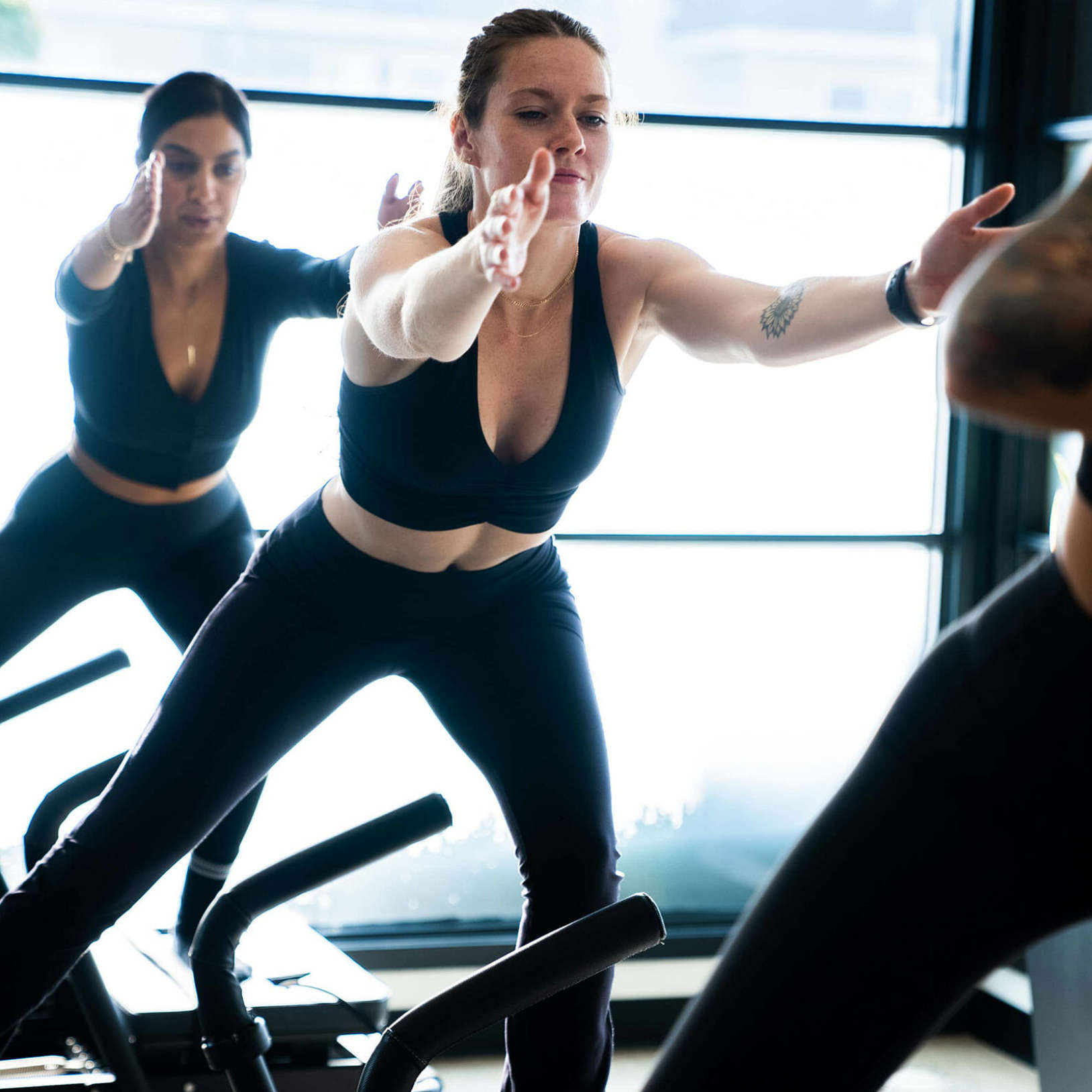
The reason a class like the X-Perience lines up well with surfing is that it is built on slow, continuous tension rather than heavy single efforts. That is the same quality surfing demands. Here is the mapping.
| What surfing demands | The physical quality behind it | Class work that trains it |
|---|---|---|
| Paddling through a long session | Lat and upper back endurance, shoulder blade control under sustained load | Strap work: kneeling and lying pull series at slow tempo, high repetitions, no rest between |
| Duck diving and pushing through whitewater | Pressing strength with a stable shoulder position | Plank series and press variations on a moving carriage |
| Turns and generating speed | Rotational strength plus the ability to resist rotation | Oblique and twist series, side plank work, anything that loads one side at a time |
| The pop up | Hip mobility and single leg power | Lunge and split leg series, skater work, deep range under control |
| Staying low and driving through a long wall | Quad and glute endurance in a bent knee position | Slow eccentric leg work and sustained isometric holds |
This is the same logic behind our post on reformer Pilates for runners. Different sport, same idea: train the qualities the sport needs in a format that does not add impact or repetition to an already loaded joint.
Why paddling more is not how you build paddle endurance
Paddling is an overhead, internally rotated, repetitive motion, and surfers do a lot of it. Adding volume to build stamina means adding volume to the exact pattern that is already getting the most work. Most surfers do not need more of that pattern. They need the muscles that support it to stop quitting first.
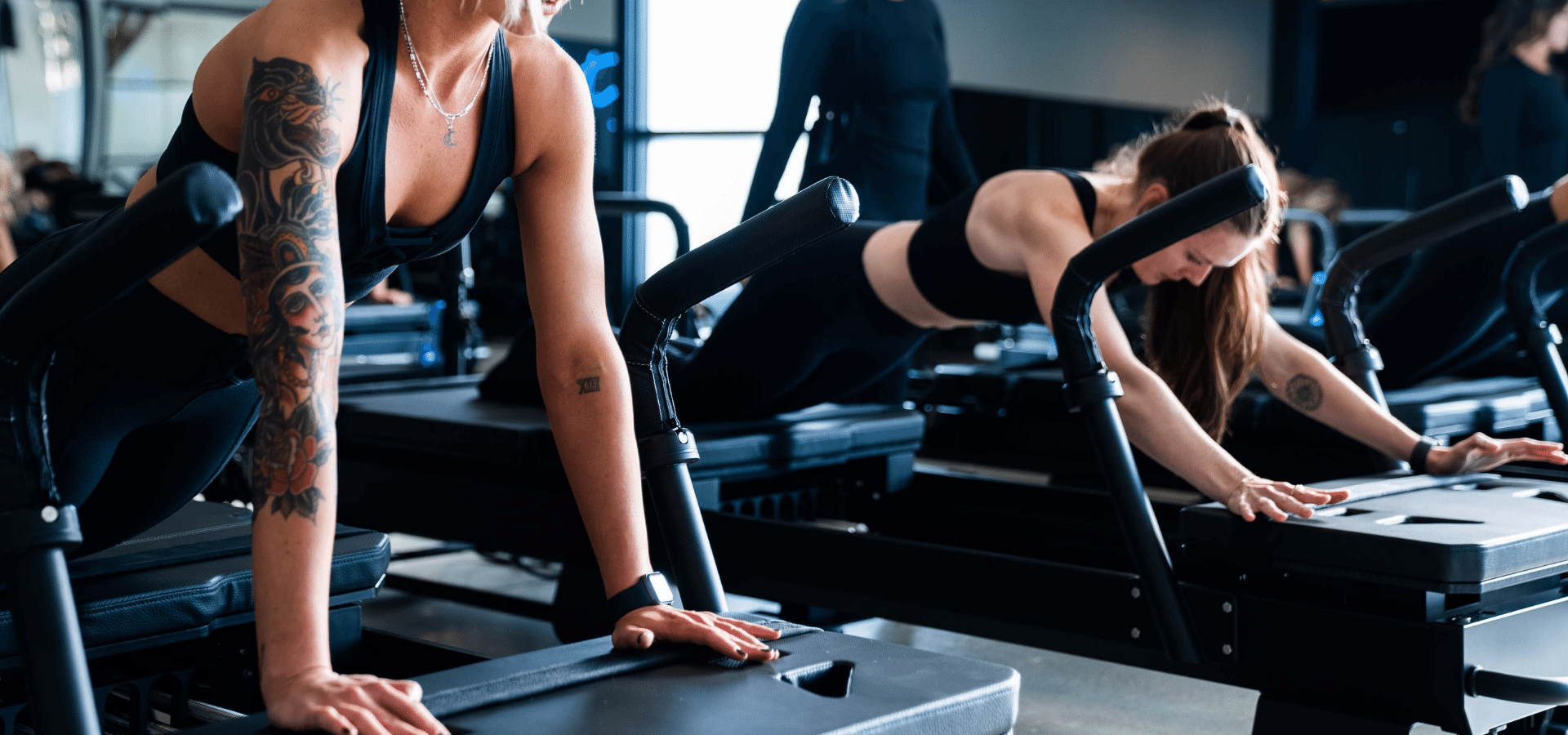
Strap work on the XFormer® loads pulling in the opposite direction of everything a surf session does. You are pulling back and down, opening the chest, and keeping the shoulder blades working through the whole set instead of letting the front of the shoulder do all of it. Do that two or three times a week and the last 20 minutes of a session feels different.
This is general conditioning, not treatment. If you already have shoulder pain that shows up in specific positions or does not settle down between sessions, get it looked at by a physical therapist or a doctor before you add training load to it.
The lower back conversation
Lower back tightness is close to universal among surfers, and the cause is not mysterious. You spend hours lying prone in extension with your head up, then you sit in the car, then you sit at work. Extension all morning, flexion all afternoon, no rotation or lateral work anywhere in between.
What helps as general conditioning is core work that is not just crunches: anti extension work like planks, side loading, and rotation under control, plus hip flexor length so your pelvis is not being pulled forward all day. A class that hits all of those in 45 minutes handles it without a separate mobility routine you will not actually do.
If your back pain is sharp, radiates down a leg, or persists off the water, that is a conversation for a medical professional rather than a fitness class.
Training through a Southern California summer
Here is the honest local reality: the water goes flat. Long stretches of a SoCal summer produce waist high and worse, and the Long Beach breakwater means most of the city’s surfers are already driving somewhere anyway. Those flat weeks are when conditioning either happens or does not, and the difference is obvious the first solid south swell in August.
Our coastal studios sit where that math is easy.
2nd & PCH is at Pacific Coast Highway and 2nd Street, which puts it minutes from Seal Beach and the Long Beach peninsula, and on the way home for anyone coming back up from Huntington. Classes start at 5AM, so a dawn patrol check and a class in the same morning is a real option when it is not working.
Newport Beach on Westcliff Drive is a short drive from the pier, Blackies, and the whole 30th to 56th Street stretch. Laguna Niguel on La Paz Road covers the Salt Creek and Doheny crowd. Down south, our Hillcrest studio and the other San Diego locations put PB and Sunset Cliffs sessions within reach of a class the same day.
Memberships and class packs work at every BE Fit location, which matters more for this crowd than most. If you chase swell up and down the coast, your training does not have to stay in one zip code.
Frequently asked questions
Is reformer Pilates good for surfers?
Yes. Surfing loads three things: paddle endurance through the lats and upper back, rotational core strength for turns, and hip mobility with single leg power for the pop up. Reformer Pilates on the XFormer® trains all three under continuous tension, which matches the endurance quality surfing demands better than heavy low repetition lifting does. It also builds pulling strength without adding more overhead repetition to shoulders that already get plenty.
Does Pilates improve paddling endurance?
It improves the strength and control that paddling endurance depends on. Slow strap and pulling work builds lat and upper back endurance and teaches the shoulder blades to stay engaged through a long set, which is usually what fails before the lats do. Nothing replaces time in the water for paddle specific conditioning, but surfers who add two or three classes a week generally report holding output later into a session.
Can Pilates help with surf related lower back pain?
As general conditioning, core and hip work addresses two common contributors to lower back tightness in surfers: weak anti extension core control and short hip flexors from hours prone on a board and hours seated off it. That is different from treatment. Reformer Pilates is not a diagnosis or a rehab program, and back pain that is sharp, radiates down a leg, or does not settle down off the water should be evaluated by a doctor or physical therapist first.
What muscles do surfers need to strengthen most?
The lats and the muscles that control the shoulder blades for paddling, the deep core and obliques for rotation and for resisting rotation, the glutes and hip flexors for the pop up and for staying low, and the quads for driving through a long wave. The upper back and the muscles around the shoulder blades are the most commonly under trained of the group, because they are the ones surfing works least directly.
How often should surfers do Pilates?
Two to three classes a week is the range that works for most surfers, scheduled on days you are not surfing hard or on the tail end of a flat stretch. If you are in the water four or more days a week, two classes is plenty and lets you recover. During flat spells, three is reasonable. Keep at least one full rest day either way.
Is Pilates better than lifting for surfing?
Neither is better, they do different jobs. Lifting builds maximum strength and is the better tool if you are genuinely weak or coming back from a long layoff. Reformer Pilates builds endurance, control, and mobility in positions closer to what surfing asks for, and it is easier to recover from during a heavy water season. Plenty of surfers do both: lift in the winter, shift toward class work when the water gets busy.
Try it before the next swell
If your last session ended because your arms quit rather than because the waves did, that is a training gap, not a fitness ceiling. Two classes a week through a flat stretch is enough to feel it.
Tell your instructor you surf when you come in. They will point out which movements to slow down on and which ones matter most for what you are after. Book a class at the studio closest to your break.